Uncategorised

Latest News

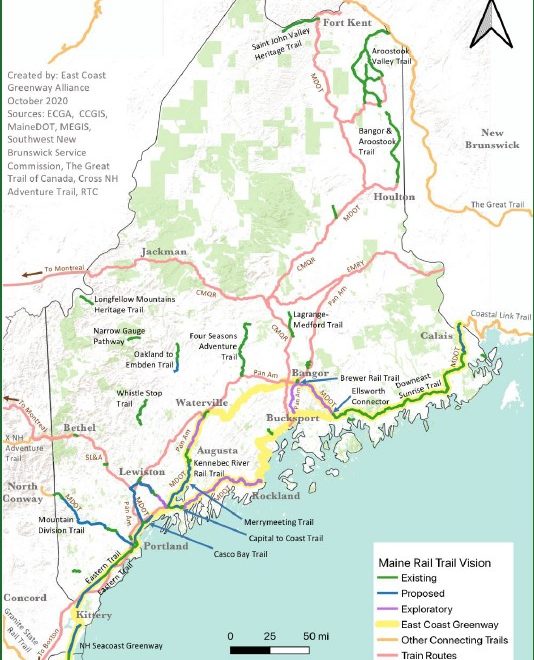
Maine Rail-Trail Plan 2020-2030

A 25-page Maine Rail-Trail Plan 2020-2030 has been released and is available for download and review.

The plan was developed by the Maine Trails Coalition (MTC), which draws together multiple Maine interest groups and citizens in a coordinated statewide effort to expand, connect, and maintain Maine’s network of off-road trails. MTC’s interests and participants span conservation, outdoor recreation, transportation, economic development, community enrichment, ecotourism, public health and fitness, climate and the environment, among others. A particular focus of MTC’s work is on regional trail connectivity.

The Maine Rail-Trail Plan calls for the construction of thirteen specific rail-trail projects over the next decade, and at least five prospective projects for development over the following decade. Each of these projects connects with, extends, and regionalizes an existing multi-use trail infrastructure. Collectively, these eighteen projects would add roughly 250 miles of inter-connected off-road trails, transforming the Maine communities they serve.

Portions of the Eastern Trail are listed both as an existing rail-trail, as well as a key part of the construction of thirteen specific rail-trail projects called for over the next decade.

The Maine Rail-Trail Plan is a living document that the Maine Trails Coalition plans to refine over time in consultation with local communities, regional authorities, state agencies, and the many interest groups concerned with rails and trails throughout Maine.

If you would like to be a part of creating an active transportation network that preserves an inter-urban train corridor, while creating healthy and connected communities throughout the state of Maine through a biking, walking, and running rail-trail system, please contact mainetrailscoalition@gmail.com. You can also sign up to receive MTC updates on all trail topics.


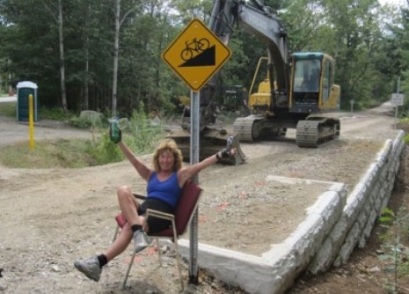
Carole Brush on the Eastern Trail
Latest News

Managing Maine’s Popular Trails: New Challenges

[Ed. Note. One of the three women this article features is our own Carole Brush, the Executive Director of the Eastern Trail Management District. Carole’s story appears last in the article]

Maine Women Magazine July 2020 |  By R. Cook

Kristine Keeney, Carrie Kinne, and Carole Brush are three Maine women who find themselves in an unexpected position that presents great opportunity and enormous challenges, thanks to the COVID-19 pandemic.

The three women manage three of Maine’s most popular trail networks from northern Maine to York County. The trails are being used by record numbers of people who crave outdoor recreation as an escape from the daily stress and anxiety generated by the coronavirus. But those record numbers also present difficult challenges to ensure everyone’s safety in the new normal of social distancing.

Kristine never thought she would ever see a situation like the one that has unfolded across the state. She serves as the New England coordinator of the East Coast Greenway Alliance. The 32-year-old lives in Greenwood near Bethel in the Western Maine mountains and is looking forward to marrying her fiancé, Jake. She originally hails from the New Haven, Connecticut, area, but Maine has always held a special place in her heart.

“I started coming to Maine in 2008 or so. It was actually for skiing in a ski club at Sunday River,” Kristine recalls. When she attended graduate school in 2013, she was living in Portland and commuting to Boston via the Downeaster. Her goal was to become the city’s bicycle coordinator.

She worked in that role for a few years and increased the bicycle network by creating more bicycle parking at a time when bicyclists wanted to have more freedom to share the road with motor vehicle traffic. “I was always into bicycle/pedestrian infrastructure.” She later accepted a planner position in Vermont for three towns near the Sugarbush Ski Resort area. She worked on a lot of trail projects in the Green Mountain State, mapped out trails for the whole region, and created user-friendly map kiosks. In July 2018, Kristine moved back to Maine when her present job was available.

She now oversees a trail network that extends from Calais to Rhode Island as part of a system that extends from Maine all the way to Key West, Florida. Maine has 340 miles, and the New Hampshire Seacoast has 17 miles, followed by another 145 miles in Massachusetts and 50 miles in Rhode Island.

In her role, Kristine works with smaller Maine trail groups like the Kennebec Estuary in Bath and the Eastern Trail Alliance in Saco that have direct management over their specific trail systems. Kristine helps them work with regional planners, local governments, and utility companies to design trails, maintain existing trail standards, and add new trails. Kristine spends a great deal of time advocating for trail funding in Augusta and keeps her trail part ners updated on important rule changes such as the COVID-19 guidelines issued by Gov. Janet Mills and
the Maine Centers for Disease Control.

Kristine is an avid biker herself. “I fell in love with it because of the flexibility and convenience, as well as the health benefits.” Biking can also help people enjoy a physical, outdoor activity while maintaining proper social distancing from others. “Biking is a great option to distance yourself from other people as well as having a great outlet for physical and mental health.”

She sees this new attention paid to biking as one of the strange benefits wrought by the current pandemic. After years of advocating for increased funding for trail networks throughout Maine and New England and spreading awareness about the health and environmental benefits of increased bicycle transportation, Kristine is seeing more people gravitate toward these causes. For example, trail use has tripled on Portland’s popular Back Cove Trail from March 2019 to March 2020, from 325 users per day to more than 1,000 daily users because of COVID-19, and that number will more than likely continue to climb as summer approaches.

As this trend unfolded, Kristine and other trail network managers were scrambling to educate trail users about the importance of social distancing. They want people to be mindful of the parking lots, for instance. If the lots are full, come back another day to use the trail, or pick a day when the weather is not as perfect, when fewer people will venture out.

“It’s a type of moving target when it comes to best practices,” Kristine said.

Maine trails are getting overwhelmed because, Kristine explains, there are more people from other communities who are traveling to different cities and towns to access those trails. Some communities have closed trail parking lots to traffic to limit access to hikers and bicyclists. When the state closed beaches and state coastal parks, that put more pressure on the existing trail network.

“It’s a situation that honestly none of us thought we would find ourselves in,” she said.

For Carrie Kinne, the executive director of the Kennebec Estuary, she and her volunteers already have their hands full striking the right balance between increased trail use and public health concerns. The Yarmouth resident oversees 30 miles of trails that include 12 preserves and 28 easements, including the latest one in Richmond.

Her trail network extends from Richmond down to West Bath and Dresden down to Georgetown. She said her group just celebrated its 30th anniversary. They have come a long way from the days when its founders were sitting around kitchen tables and first discussed protecting vast tracts of land to protect natural habitat and allow public enjoyment.

Carrie completely understands why so many people who may have never enjoyed the Kennebec Estuary’s trails are using them now. “There are things you think of when you think of Maine, like nature, the environment, and the landscape. If you are from Maine, you may take it for granted.”

Carrie is hopeful the trail scout program they started when COVID-19 really took off in Maine will pay dividends. The program allows people to share their observation about the trails. “It’s getting a lot of traction.” Trail scouts also report the activity they are seeing on the trail, as well as trail conditions, to serve as the estuary organization’s eyes. As a result, more people in the community feel vested and engaged in the Kennebec Estuary’s work.

Carrie said the estuary’s corps of volunteers will make sure the trails are nice and wide to accommodate the growing number of users they will see this summer. “There are going to be
busy times, but ultimately you try to get the message out there as best you can,” Carrie said. “There should be ample space for everybody out there.”

Carrie has also been vested in Maine’s environment and its position as a leader in preserving public lands. She is originally from Farmingdale and spent a great deal of her career in the healthcare industry before she joined the Kennebec Estuary. “Out of all the non-profit work that I’ve done, this is incredibly rewarding.”

Carrie has been married to Jack for 20 years and the couple have four stepchildren and seven grandchildren, all under age nine. The kids love exploring the trails as much as Carrie does.

Meanwhile, the situation in southern Maine could be more complex for Carole Brush. As the executive director of the Eastern Trail Management District in Saco since 2007, Carole has already seen trails like Scarborough Marsh get overwhelmed with users to the point where social distancing was impossible. Carole said a survey showed the number of Scarborough Marsh trail users increased from 4,000 in April 2019 to 12,000 this April. In May 2019, they saw 7,000 people use the same trail compared to a projected 21,000 people this May.

“Maybe the big benefit of all this is that people are getting out more and exercising more and are really taking advantage of what we have,” Carole believes. “The use of the trail has tripled from what it was a year ago.” In some ways, it’s a nice problem to have for trail advocates who are always looking for ways to extoll the trail network’s benefits. But like her colleagues Kristine and Carrie, Carole could never have foreseen a situation like this unfolding in 2020.

She has been with the Eastern Trail Management District (EMTD) since 2007. She wanted to live in Maine to be close to her family and become an Audubon Society registered guide for the Scarborough Marsh. Since her earliest years growing up in New Jersey, Carole has had a love affair with nature.

“From the time I was a child, going out to nature was always my go-to place,” she said. “Maybe the big benefit of all this is that people are getting out more and exercising more and are really taking advantage of what we have.” Carole studied land conservation when she attended Ramapo College in New Jersey and ended up splitting her time between Boulder, Colorado, and New York State for the next 10 years. “It was a pretty tough commute, but it was worth it.”

In New York, Carole led hikes and taught fitness classes at the Mohawk Preserve and the Mohawk Mountain House in the Hudson Valley region. Carole has five grandchildren and has been single for quite a while. “My work is a big part of my passion, to be out there on the trails and keep conserving land for trails.”

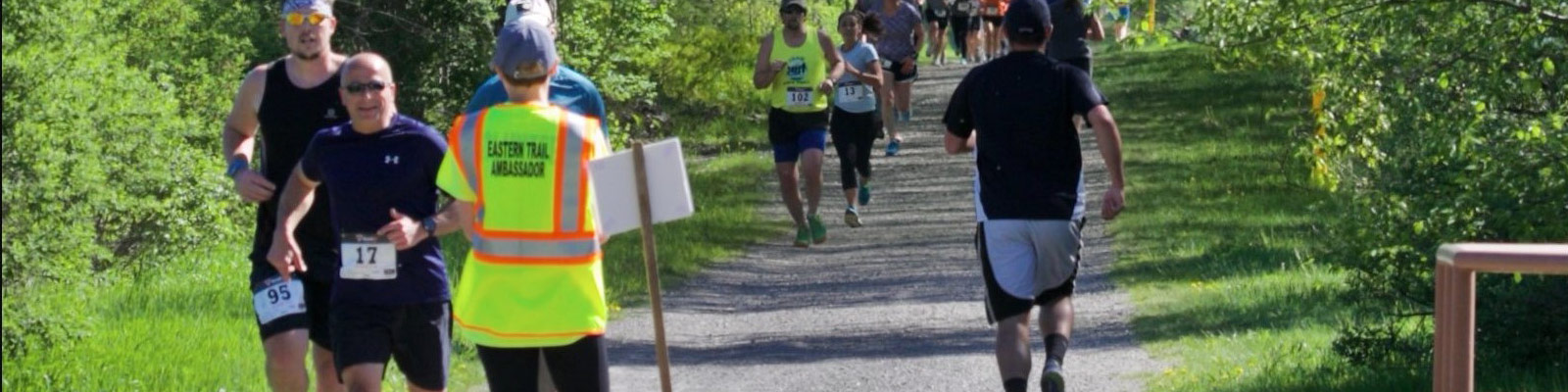
Carole said her volunteers will continue to post signage and utilize social media to spread the word about the importance of social distancing so everyone can enjoy the trails. They will also have trail ambassadors to guide people to stay six feet apart. More importantly, the public’s willingness to comply with the new normal will ensure the trails remain open.

Even as the COVID-19 pandemic dominates their attention, Carole said the ETMD is still working on three projects to expand and improve the existing trail network. One involves creating a 1.6-mile link between South Portland and Scarborough. The other two projects involve a three-mile stretch to connect Thornton Academy in Saco to Southern Maine Medical Center in Biddeford and an 18-mile stretch from Kennebunk near Alewives Road south all the way to South Berwick. The work to maintain and expand existing trail networks and to educate the public about how best they can enjoy them now is an ongoing process.

“It takes a village or several to build a trail,” Carole observes. It may also take several villages to keep the trails safe and accessible this summer and beyond.

Latest News

East Coast Greenway’s WeekAYear video: Maine to Florida ride over 9 years

Take a look at this excellent “Week-A-Year” video put together and shared by Dave Read of the East Coast Greenway Alliance.

Nine years ago, riders started at the Canadian border in Calais, Maine and began a ride south along the 3000-mile East Coast Greenway. They rode for a week each year. For example, they biked the first year (2011) from Calais to Portland.

On Friday, November 15, 2019 a group of 40 cyclists plus support staff reached Key West, Florida, to wrap the final leg of the East Coast Greenway Alliance’s Week-A-Year (WAY) Tour.

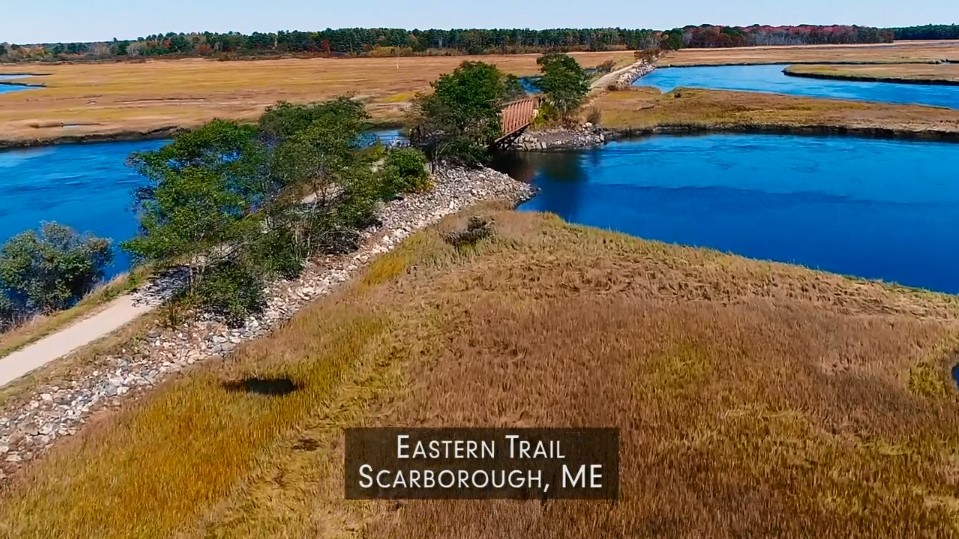
In 2012 they traveled along the Eastern Trail,  and the brief ET segment (starting at 2:02 on the video) includes a nice aerial-drone-shot along the Scarborough Marsh.

The video is a collage of trip videos and photographs that includes an engaging narration about the yearly rides and the Greenway.

Dave Read lives in Massachusetts, is currently a member of the Greenway Council, and chaired the Board of Trustees of the East Coast Greenway Alliance from 2011 through 2015. He is also the Vice President of Ambulatory Care Operations and Medical Oncology at DanaFarber Cancer Institute.

Latest News

Maine Voices: Vision for regional greenway development includes current, future train passage

[Eds. note: This article includes information about legislation currently being considered, LD 2124 – “An Act To Create the Rail Corridor Use Advisory Council Process,” which would ensure that unused Maine rail corridors don’t stay stagnant indefinitely. Sue Ellen Bordwell of Yarmouth is president of the Casco Bay Trail Alliance. Dick Woodbury, also of Yarmouth, served 10 years in the Maine Legislature and is on the board of the East Coast Greenway Alliance.

A related article is here.  An advocacy page on LD 2124 can be found here]

By SUE ELLEN BORDWELL AND DICK WOODBURY,  published March 12, 2020

We are tangibly close to having a continuous off-road greenway that connects the communities from Kennebunk to Portland, Westbrook, Lewiston-Auburn, Brunswick and Augusta. Situated along many of the major commuting corridors in southern Maine, this regional trail network would be among the most frequently used in America, promoting health and fitness, reduced greenhouse-gas emissions, tourism, economic development and enhanced community life.

Critical to achieving this vision is the repurposing of four state-owned rail corridors in our region, much like the repurposing of a rail corridor purchased by the state of New Hampshire for their greenway path from Portsmouth to the Massachusetts border. In Maine, three of these corridors are already state-owned, unused by trains and largely redundant with separate and active rail corridors that can be cost-effectively maintained for current and future train passage.

• Project 1, the Casco Bay Trail, uses the former St. Lawrence & Atlantic corridor from Portland to Yarmouth. Importantly, an active rail line used by the Amtrak Downeaster already provides train passage from Portland through Yarmouth on its way to Freeport and Brunswick. The St. Lawrence & Atlantic is a totally separate corridor on essentially the same route. This is a case where no rail-versus-trail controversy seems necessary. We can have both: a well-maintained track for active rail use and one of the most popular greenway trails imaginable.

To the south, the Casco Bay Trail would connect to the Portland Trails network, including Back Cove, the Eastern Promenade trail and 22 off-road miles of the Eastern Trail from South Portland to Kennebunk. To the north, it would connect to the Beth Condon Pathway, running from Yarmouth to the Freeport YMCA, and the West Side Trail, running from western Yarmouth to the far end of Cousins Island. L.L. Bean and the town of Freeport are also collaborating on a trail extension from the YMCA to downtown.

Constructing the Casco Bay Trail in no way inhibits passenger train service from Portland to Lewiston-Auburn. The Amtrak Downeaster could easily fork from its existing corridor with one track going to Freeport-Brunswick and the other to Lewiston-Auburn. Indeed, an exciting vision is taking shape with Amtrak stops at turnpike Exit 53 in West Falmouth and Pineland and turnpike Exit 72 in Auburn and downtown Lewiston-Auburn. The Casco Bay Trail is complementary with this vision.

• Project 2, the Merrymeeting Trail, repurposes an unused rail corridor from Brunswick and Topsham to Gardiner. It connects the Kennebec River Rail Trail to the north with the Androscoggin River Bicycle and Pedestrian path to the south, advancing a 40-mile “Capital to Coast” trail system. For commuting purposes, it serves residential communities surrounding Augusta, Brunswick, Topsham and eventually Bath. It would be a spectacular greenway through villages, forests and fields and along rivers.

Read the entire article online here.


Latest News

Eastern Trail in Portland, Maine – Photo essay by Cindy Barks (Rails to Trails Conservancy)

A PHOTO ESSAY OF THE EASTERN TRAIL WAS PUBLISHED IN THE 2019 GREEN ISSUE OF RAILS TO TRAILS MAGAZINE.

From quiet pine forests to a bustling working waterfront, and from wide sandy beaches to rocky shores, the 65-mile Eastern Trail—currently 30 percent complete—offers a vivid snapshot of Maine’s many charms. The multi-use trail, which follows the corridor of the historic Eastern Railroad, packs plenty of variety into its north-south route from South Portland to Kittery.

Along the way, trail users can take in lobster boats skirting the picturesque Bug Light lighthouse in South Portland, watch snowy egrets wading in the ponds of the Scarborough Marsh, or detour a few blocks to dip their toes into the Atlantic Ocean at Old Orchard Beach. The trail also passes through dense pine forests and quaint coastal towns.

Within the next year or two, organizers say a 1.6-mile gap will be closed, allowing trail users to travel off-road for more than 16 miles from Bug Light to Saco. The Eastern Trail is also a part of the much larger 3,000-mile developing East Coast Greenway.

To view the 25 captioned photos in the photo essay, go to the 2019 Green Issue of the Rails To Trails magazine.

Latest News

Eastern Trail: Showcasing Some of the Best of Coastal New England

[Ed.s Note – This story appeared in the Fall 2019 Rails to Trails magazine published by the Rails to Trails Conservancy]
STORY AND PHOTOS BY CINDY BARKS

As I dipped my toes into the chilly surf of the Atlantic Ocean, I had to marvel at the spectacular diversity along the Eastern Trail that runs through the coastal region of southern Maine.
During my several spring days of meandering along the 29-mile stretch from South Portland to Kennebunk, I stared down a raccoon in the deep pine woods in Kennebunk, watched lobster boats comb the blue waters of Portland’s Casco Bay and was awed by a flock of graceful snowy egrets wading in the saltwater ponds of the Scarborough Marsh.
And that’s not even mentioning my day at Old Orchard Beach, beach combing along a 7-mile strand of wide, sandy oceanfront complete with a quaint pier, amusement park and multiple places to buy fried dough and pizza slices.
Not only was the beach a lovely bonus after my days of walking and bicycling on the trail, but it brought me full circle, ending at a tourist attraction central to the Eastern Trail’s early history.
Trains and Trolleys
By the mid-1800s, tourism was well under way in coastal Maine. The Eastern Railroad dates back to 1842, when the Portland, Saco and Portsmouth Railroad line opened as the first railway between Portland and Boston.
A few decades later, the Portland Electric Railroad Company connected a trolley line to the railroad route to give tourists arriving in Portland direct access to the “Grand Beach at Old Orchard.”
Although increasing automobile use brought an end to the rail line in 1945, efforts were under way a half century later to use a portion of the disused right-of-way as a recreational/nonmotorized transportation trail. The Eastern Trail Alliance (ETA) was born in 1998, and the first section of the Eastern Trail opened at Scarborough Marsh in 2004.
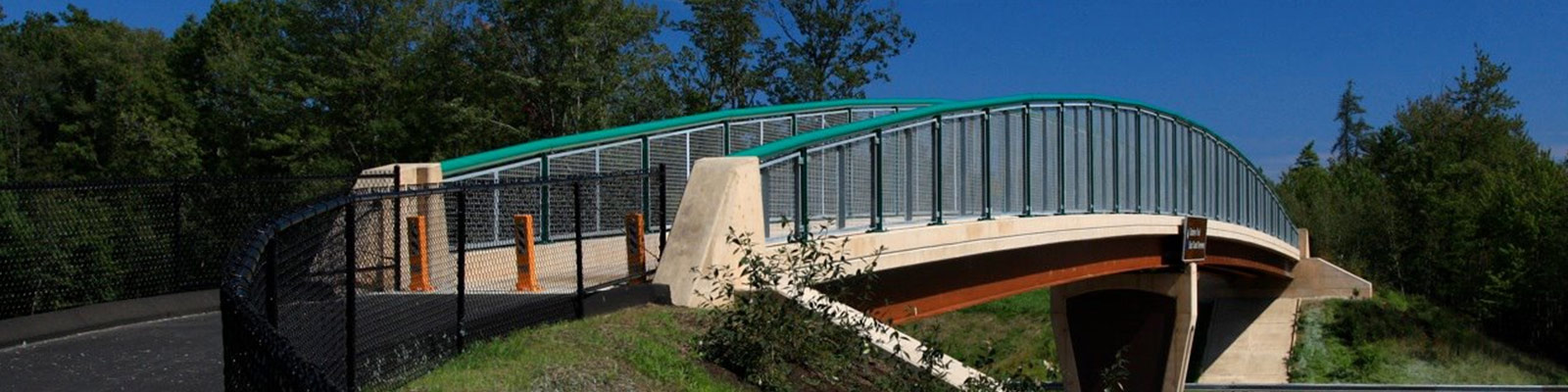
The ETA’s vision for a 65-mile off-road trail is about 30 percent complete, which means that the route combines off-road sections with well-marked on-road sections. Trail completion will get a major boost in the next year or so, when two new bridges will be built, closing a gap and making for a continuous 16-mile off-road stretch between South Portland and Saco.
Today the Eastern Trail already boasts many jewels. Carole Brush, executive director of the Eastern Trail Management District, told me that Old Orchard Beach “is southern Maine’s go-to spot in the summer.”
Lighthouses and Lobster
Another of the trail’s most popular destinations is the 5.5-mile greenbelt that begins on the trail’s northeastern end at Bug Light Park and the Bug Light (Portland Breakwater) lighthouse in South Portland.
With its expansive view of the Portland Harbor and its 1875-era lighthouse, Bug Light Park was the perfect place for me to start my exploration of the trail. As I admired the lighthouse’s Corinthian-column design, I noticed locals arriving by car or on bikes, greeting one another and setting out to walk their dogs along the park’s pathways.
Mark MacIsaac, who visits the park daily with his dog Phoebe, told me the park and its trail are a beloved community amenity. “South Portland has done an incredible job,” he said. “We take great pride in the parks, and certainly in this trail.”
That community pride was apparent as I proceeded southwest past the park’s informative Liberty Ship Memorial, which commemorates Maine’s massive World War II shipbuilding efforts, and along the wide, paved greenway that traverses neighborhoods and hugs the harbor’s edge.
Framed by the distant Portland skyline, the sea tides were putting on a show as I walked by, ebbing to reveal the harbor’s sandy bottom and beautiful channels.
South Portland’s booming restaurant and brewery scene was also on display. Nearing downtown, I made a quick coffee stop at Verbena, a creative breakfast and sandwich/bowl eatery on Ocean Street, just blocks from the trail. Later I took another short detour to Cape Whoopies for a sample of Maine’s official state treat—the decadent, irresistible whoopie pie.
An even larger array of restaurants and breweries is just across the Casco Bay Bridge in downtown Portland. In the popular Old Port, lobster is king—and countless restaurants and bars feature Maine’s most famous food. I joined locals on my first evening in Portland at perennial favorite J’s Oyster for a twist on scampi—featuring lobster, of course!
The downtown Portland spots are all within easy reach of the Eastern Trail and other attractions on foot or bicycle. One morning I joined a bike tour organized by Portland’s Summer Feet cycling and rode from the Eastern Trail to three scenic lighthouses: Portland Breakwater, Spring Point Ledge and Portland Head. (During the summer, the bike tour includes the twin lighthouses at Two Lights State Park as well.)
Off-Road and On-Road Mix
Moving on from South Portland, I visited the Scarborough Marsh, Maine’s largest saltwater marsh, where I walked for a couple of miles with Carole Brush and Nancy Borg, ETA executive director.

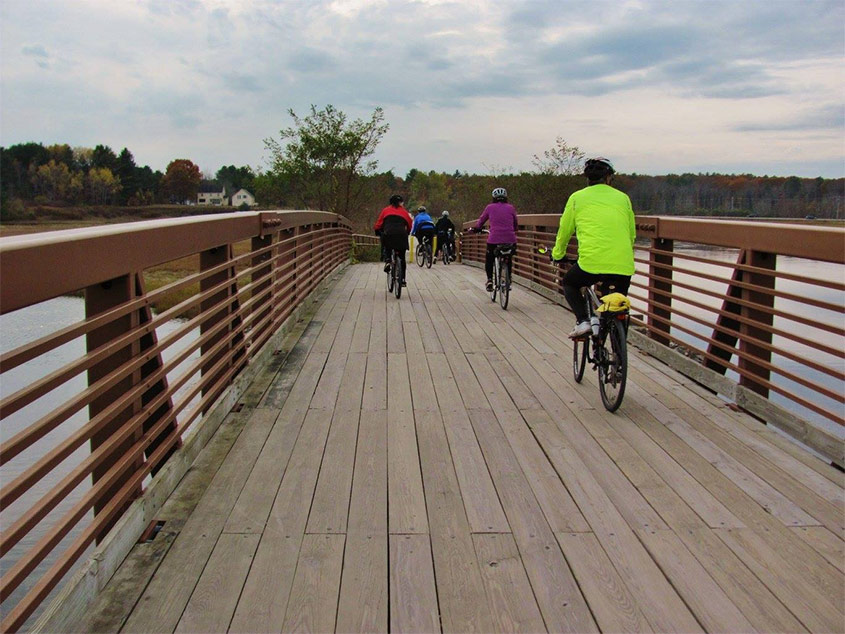
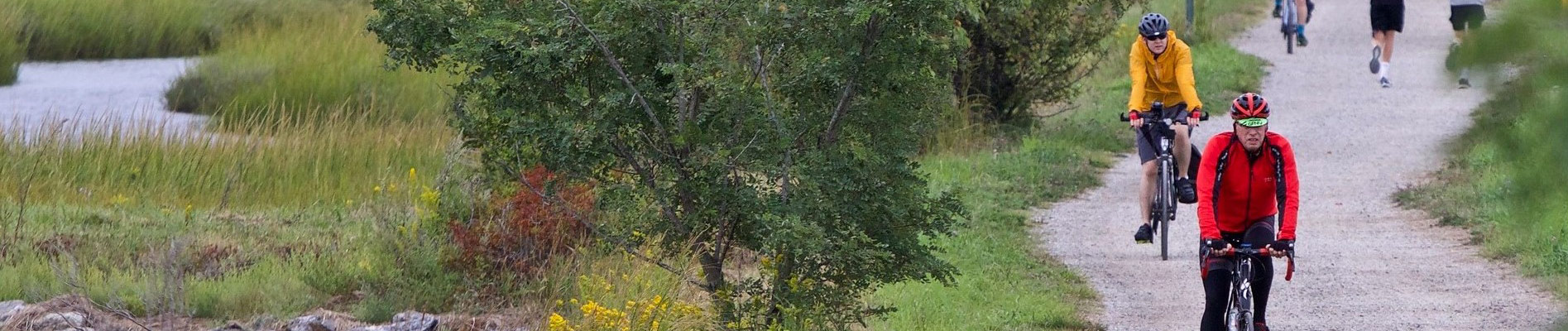
I quickly learned that, similar to South Portland, the nearby Scarborough and Saco communities are big boosters of the trail. The day I visited, the trail was busy with runners, bicyclists and families with small children. “It’s flat, so it’s for everyone,” Borg said.
Patrick O’Reilly, who with his wife, Sue, owns the Scarborough pub O’Reilly’s Cure, said he became involved with the trail years ago at the urging of his friend John Andrews. Andrews, who died in 2017, is credited with founding and mentoring the Eastern Trail. For the past three years, O’Reilly’s Cure has sponsored the John Andrews Memorial Eastern Trail 5K, a trail fundraiser.
O’Reilly sees the trail as an economic boon for local businesses, and a place to experience the region’s unique natural landscape. “It is fantastic that within five or 10 minutes from anywhere in town, you can be on that trail, and in a different world,” he said.
Farther along, the terrain transitions abruptly from marsh to woodlands. As the trail passes through the quaint towns of Biddeford, Arundel and Kennebunk, white pine trees tower overhead. Even though I knew that houses, schools and roads were nearby, this section of trail felt like deep wilderness.
Brush said the trail’s changing landscape and diverse uses are among its major assets. “Each year over 250,000 people enjoy this amazing resource for transportation, exercise, ‘forest bathing,’ bird watching and many, many other activities,” she said, quoting from the trail’s mission statement.
After spending several days exploring the route’s northern half, I couldn’t help but agree: For my first taste of Maine, the Eastern Trail was the perfect showcase.
Accessing the Trail
Bug Light Park at the northern end of the trail is a convenient access spot. It offers plenty of parking, as well as views of the picturesque Portland Breakwater Lighthouse. From the Portland International Jetport, take Jetport Boulevard to Congress Street and then turn right on Fore River Parkway. Continue onto Commercial Street and exit onto Highway 77 South/Casco Bay Bridge. Continue onto Broadway to Madison Street.
What to See
One of the Portland area’s foremost attractions is the Portland Head Light — the iconic lighthouse perched on the edge of a beautiful and rocky cliff. Old Orchard Beach is a 30-minute drive from downtown Portland, and just a couple of blocks off the Eastern Trail. Just down the trail is Scarborough Marsh, Maine’s largest saltwater marsh.
Where to Stay
For a newspaper-themed stay in downtown Portland, check out the Press Hotel, the luxuriously renovated former offices of the Portland Press Herald. The Holiday Inn by the Bay offers rooms at a reasonable rate with sweeping views of downtown Portland and Casco Bay. Campers can be within a mile or so of the trail at Bayley’s Camping Resort in Scarborough; it has a variety of accommodation choices.
Breweries
Portland, a city of about 65,000, boasts an estimated 18 breweries, which puts it at the top of lists of communities with the most breweries per capita. Among the best are Allagash Brewing Company, Fore River Brewing and Shipyard Brewing Company.
Where to Eat
For brunch or dinner right along the Eastern Trail in Scarborough, O’Reilly’s Cure offers classic New England chowder and crab cakes in an Irish pub setting. In nearby Portland, visitors need remember just one word — lobster. Enjoy authentic lobster rolls, along with other seafood choices, at Bite into Maine (biteintomaine.com), The High Roller Lobster Company or J’s Oyster. For a Maine breakfast said to be favored by lobstermen, head to the local favorite, Becky’s Diner.
Where to Rent
Portland EnCYCLEpedia offers a range of bike rentals, and Summer Feet Cycling leads informative bike tours. Fun and Sun Rentals in Scarborough provides bikes, kayaks and stand-up paddleboards. Maine Audubon has a kayak and canoe rental site on the Scarborough Marsh, just steps from the Eastern Trail.•

VIEW A PHOTO ESSAY OF THE EASTERN TRAIL IN THE 2019 GREEN ISSUE OF RAILS TO TRAILS MAGAZINE

Cindy Barks is a freelance writer/photographer and Arizona newspaper reporter who has covered trails extensively in her community and in the Southwestern United States. She also writes a  travel and hiking blog at nearandfaraz.com.
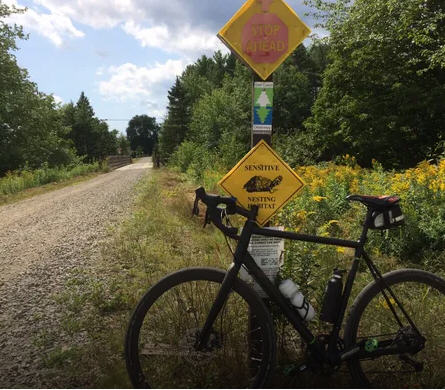
Share the trail sign image
Latest News

Everyone can benefit from simple trail rules

Eds. note: The following Letter to the Editor appeared online in the Portland Press Herald on July 12

Editor,

The weekend of June 29, representatives of the Eastern Trail, along with Bicycle Coalition of Maine and AARP, had a wonderful walk and bike ride on the Scarborough portion of the Eastern Trail. It was a pleasure seeing so many people on the trail walking and riding their bikes.

Read more

Latest News

Trail etiquette for all users

Eds. note: The following Letter to the Editor appeared online in the Journal Tribune on June 11

Editor,

The weekend of June 29, representatives of the Eastern Trail, along with Bicycle Coalition of Maine and AARP had a wonderful walk and bike ride on the Scarborough portion of the Eastern Trail. It was a pleasure seeing so many people on the trail walking and riding their bikes.

Read more

Latest News

East Coast Greenway: Hike or bike your way from Maine to Florida

[Ed. Note: The Eastern Trail is specifically mentioned in this article that appeared in USA Today on March 22]

East Coast Greenway will connect trails from Maine to Florida
The 3,000-mile East Coast Greenway connects biking and walking paths and will eventually create a park from the Canadian border to Key West, Florida.

In 2015, Florida cyclist Stefanie Boewe suffered a collapsed lung. During her long recovery she read an article about the East Coast Greenway, a 3,000-mile route that connects existing biking and walking paths and will eventually create a linear park from the Canadian border to Florida’s southernmost point. Having grown up in Germany, touring by bike as a child, Boewe realized she missed long-distance cycling. As she recuperated, she began daydreaming about biking the greenway and visiting friends along the East Coast.

“I thought, ‘If I ever recover from this, I’m going to tell these lungs that they can’t say what I can and cannot do,’” Boewe said. “Plus, I had adopted this dog who goes crazy running with a bike.”

In 2017, over a stretch of 89 days, Boewe biked the entire greenway from Key West, Florida, to Calais, Maine, pulling a trailer and accompanied by her 6-year-old Australian shepherd, Murf. She joined a small tribe of cyclists and walkers who have taken on the whole greenway — even though it’s only one-third complete. For these pioneers, creating a patchwork route of protected paths and sometimes-busy roadways was a small price to pay for the adventure — and bragging rights — of being among the first to complete the East Coast Greenway.

Read the entire article on-line here.

https://www.easterntrail.org/