

Many articles about the Eastern Trail are organized on this news archives page. The most recent articles appear immediately below, with the first part of each article displayed. Click on any article title, or the “Read More..” link to read the full text of that article.
by Jeff LaGasse
Biddeford Journal Tribune
March 2, 2012
With the beginning of the spring season on the horizon, those who walk or ride on the Eastern Trail — the epic walking and hiking trail that runs through several communities in Southern Maine — will soon be witness to the sights that trail allows: Bicyclists cruising, families walking, and dogs wagging their tails. What they may not see is the presence of horses on the trail. That, it seems, has become a point of controversy.
Read the full article (pdf format) here.
Ed.’s note: This story about the Eastern Trail about the ET’s Saco-Old Orchard Beach section tops the New England Regional Update portion of the January 2012 East Coast Greenway Alliance E-Newsletter.
 The Eastern Trail Alliance announced that construction is now complete along its newest section of trail, which stretches from Thornton Academy in Saco to Milliken Mills Road in Old Orchard Beach and includes a bridge that spans Route 1 in Saco just north of Ross Road.
This newest success, coming just four months after the opening ceremony for the Eastern Trail Turnpike Bridge just north of Exit 25 in Kennebunk, is certainly cause for celebration. The Saco-OOB section’s 4.4 miles provides another crucial link in the development of a 65-mile greenway in southern Maine. With the completion of this new section, 85 percent of the trail is now developed off-road north of Kennebunk.
John Andrews is the motivating force behind southern Maine’s expanding off-road trail system.By Deirdre Fleming dfleming@mainetoday.com Staff Writer ARUNDEL – The trail was slick with sleet Friday morning and the rain was cold, but John Andrews happily covered ground in his work boots as he gave a tour through the wood-lined path leading to the Kennebunk River. It was the newest section of the Eastern Trail, and after several trail “unveilings” in as many years, Andrews is getting used to showing off this ever-expanding off-road trail in southern Maine. The Eastern Trail begins at Bug Light in South Portland and the plan is to extend it all the way to Kittery, some 70 miles. It currently travels off road in sections through South Portland, Scarborough, Saco, Old Orchard Beach and now, with the newest section, across Biddeford, Arundel and Kennebunk. |
John Andrews points toward Kennebunk as he shows off a new section of the Eastern Trail in Arundel where it crosses the Kennebunk River with a new bridge. The trail is part of the 3,000-mile East Coast Greenway. |
Read the full article online here.
By Jack Beaudoin, Portland Press Herald – Thursday, February 12, 1998
Anybody who has ever tried to bike from Kittery to Portland knows one thing for certain: If you value your life, you can’t get there from here.
That’s because the world’s most pedestrian-unfriendly, bike-unfriendly road – Route 1 – dominates the north-south corridor through York County.
Overburdened by seasonal tourist traffic, narrow through the shoulders, rutted and pot-holed, Route 1 cuts across just about every other road in coastal York County and serves as a real barrier to safe alternative transportation and recreation.
But John Andrews, chairman of Saco Trails, may have found a way around it – the Eastern Trail. In his dream, the Eastern Trail provides a lush, beautiful four-season corridor for cyclists, hikers, inline-skaters, cross-country skiers and snowshoe enthusiasts to travel.
The best thing about Andrews’ dream is that the trail already exists.
You might know the Eastern Trail by its old name, the Boston and Maine Eastern Line. Until 1945 – the year it was abandoned – trains ran the 50-mile stretch of the Eastern Line from South Berwick to South Portland. Since then, the line has remained mostly dormant, an overgrown scar cutting across the heart of York County.
But Andrews plans to bring the Eastern Line back to life. Along with Alan Cone of Saco Trails, Dick Roberge of Old Orchard Beach Trails, Tom Daley of the Scarborough Conservation Land Trust and public officials from Saco to South Portland, Andrews has managed to secure almost all the approvals needed to complete the northern edge of the trail from Route 1 in Saco to Bug Light in South Portland.
With that part of the job steaming toward completion, the committee has turned its sights on the southern stretch, from Saco to Dover, N.H.
“I don’t see why this can’t be done in a matter of years,” says Andrews, a 61-year-old semi-retired engineer with a penchant for hiking, biking and cross-country skiing. “I believe if you get a bunch of people together in these southern communities, the trail will happen.”
In fact, the speed of the Eastern Trail’s development is nothing short of astonishing. Although Daley has been looking into the project’s feasibility for 11 years, Andrews and his conservationist friends formed an exploratory committee just about three weeks ago. Since then, Granite State Gas Transmission Inc. (which owns a natural gas pipeline on much of the proposed trail) has enthusiastically signed on to the project, as has the town of Arundel.
“We’ve already talked a lot about it,” says Arundel Planner Roger Cole, who has passed Andrews’ plans southwest to Kennebunk planners. “Who wouldn’t, with a corridor like that? The Eastern Line is just there for the using.”
According to Cole, the Eastern Trail would be a boon to residents and visitors alike. And if Andrews has his way, people could be coming to the state from as far away as Florida. Andrews has been talking to representatives of the East Coast Greenway project, a trail system that someday will connect Bar Harbor to Key West.
Parts of the Greenway, like the Eastern Trail, would be off-limits to motorized vehicles while other stretches would cut through the center of cities like Boston and New York. The more access, the Greenway philosophy goes, the better.
“It’s not their intention to make this an Appalachian Trail for bikes,” Andrews says. “They want it to go where the people are. And if that means going through cities, so be it.”
SeaCoastOnline.com January 26, 2012 2:00 AM
The Eastern Trail Alliance got its start in 1980. The idea was to provide a 65-mile public access trail from Portland to Kittery. The completion of the pedestrian bridge over I-95 in Kennebunk is testament to the hard work and successful forging of partnerships with local, state, and federal entities.
ETA has expanded its goals and is now a part of the East Coast Greenway, a trail system that stretches 3,000 miles from coastal Maine to Key West, Fla.
Each community along the way offers a connection to the project; it might be an abandoned railway system or land running parallel to a natural gas line. Many trails offer long quiet stretches for hikes or bike riding. Horses are allowed but motorized vehicles are prohibited. Not all of the trail is off-road — more about that a bit later.
The East Coast Greenway started in 1991 with the vision, “For a long-distance, urban, shared-use trail system linking 25 major cities along the eastern seaboard between Calais, Maine and Key West, Florida. It will serve non-motorized users of all abilities and ages. A 3,000-mile long spine route will be accompanied by 2,000 miles of alternate routes that link in key cities, towns, and areas of natural beauty. This green travel corridor will provide cyclists, walkers, and other muscle-powered modes of transportation with a low-impact way to explore the eastern seaboard.” Cool, eh?
ECG provides a list of 53 maps, each averaging about 53 miles of trails. Each map shows elevation levels for its coverage.
Presently, 75 percent of the Greenway is on public roads and the traveler must be aware and conscientious of roadside safety. ECG recommends that only experienced cyclists use the sections that must share the road with motorized vehicles. Recommendations are listed at the end of this article. Hikers, less experienced cyclists, and equestrians will find miles of quieter off-road trails with beautiful natural settings.
Many of the off-road trails are in rural settings but even they eventually come close to local businesses that benefit from trail users stopping in for refreshments.
Volunteers maintain the trails with funds donated, membership dues (you don’t have to be a member to use the trails), and bond initiatives for large projects.
Today we have this opportunity to offer this great legacy to future generations of outdoor enthusiasts.
Find out more about the Eastern Trail Alliance by contacting: Eastern Trail Alliance, P.O. Box 250, Saco, ME 04072 or call 284-9260 or visit www.easterntrail.org
Some upcoming excursions on the trail:
RJ Mere is a Registered Master Maine Guide and noted naturalist. He can be reached at rjmere@gwi.net.
User safety recommendations from East Coast Greenway:
East Coast Greenway information can be found by contacting: East Coast Greenway Alliance, 5315 Highgate Drive, Suite 105, Durham, NC 27713 or call 919-797-0619 or e-mail info@greenway.org.
Read this article online at SeaCoastOnline.com
ETA note: Coverage on this site of the federal Transportion bill, and what it might mean for trails and bicycling programs, started on February 13. This latest version of the report was updated March 14.
As some of you may have heard, there is a major legislative battle going on around the federal transportation bill. Many friends in the national bike advocacy groups have pulled out all the stops to get the Senate version of the bill passed containing provisions that help trails and bicycling programs. Click here for one news report on the bill’s passage.
Many friends here in Maine were also active in contacting Maine’s two Senators to urge their support for the bill. Click here to read the City of Saco’s Resolution in Support of Transportation Enhancement, Recreational Trails and Safe Routes to School (passed Feb. 28, 2012)
THANK YOU very much for your efforts to help protect trail funding.
The Senate passed its version of the transportation bill on Wednesday, March 14.
An email alert sent March 13 by Kevin Mills of the Rails-to-Trails Conservancy provides some good information on the eve of the bill’s passage:
“Thanks to your valiant support, I am thrilled to report that because of bipartisan bill changes just filed by Senate leaders, we expect that a final Senate transportation bill will include two amendments that restore the integrity of trails, walking and bicycling programs.”
“Under the bill as passed by the Senate Environment and Public Works Committee last November, Transportation Enhancements (TE), Safe Routes to School (SRTS) and the Recreational Trails Program (RTP) would have become severely crippled.”
“But the incorporation of these two amendments is a huge step forward for trails and active transportation. A vote on final passage of the bill is expected very soon, but I couldn’t wait to tell you about this important breakthrough for trails and active transportation. The bill will ensure greater local access to funds and a fair shot at approval for the most beneficial projects, and it preserves decision-making structures that enable public participation and well-balanced trail systems. The messages you sent your senators made an enormous difference.”
Mr. Mills goes on to report on what is happening in the House of Representatives:
“Meanwhile in the U.S. House of Representatives, the draft transportation bill (H.R. 7) failed to attract enough support. We do not yet know whether the House will change its own bill, take up the Senate’s bill, or simply move to extend funding under existing law.”
“But House leaders must act fast, as the clock is ticking on the current transportation law, set to expire on March 31. As always, we will seek your assistance when necessary to defend TE, SRTS and RTP so they can continue to make our communities healthier, wealthier, safer, cleaner and more enjoyable. (For more on the bill debate, see this excellent Hill article.)”
Two major organizations in Maine, the Bicycle Coalition of Maine, and the Biddeford/Saco Chamber of Commerce, bestowed honors in January 2012 on John Andrews, the founder and President Emeritus of the Eastern Trail Alliance.

 The Bicycle Coalition of Maine honored John Andrews with one of their annual awards for “individuals for their work to improve bicycling in Maine.” The Biddeford/Saco Chamber of Commerce honored John with the William Kany Leadership Award.
From the 1/19/2012 Bicycle Coalition of Maine announcement:
 “Andrews, a retired engineer, served as founding president of the Eastern Trail Alliance until last summer. For 15 years, he led the effort to create a multi-use trail from Kittery to South Portland. Along the way, he secured funding, convinced municipalities to work together, won support from politicians and overcame many other obstacles. The trail now extends for nearly 21 miles in southern Maine.
Andrews “met an enormously wide array of people with all sorts of connections to his Eastern Trail dreams – directors of corporations, everyday common citizens, Mainers, people from away,” said Jim Bucar, an Alliance trustee. “He stores all their names and histories and details in his voluminous memory, ready to extract them when it would benefit the trail to reach out to them.” “

The Biddeford/Saco Chamber of Commerce honored John on January 24 with the William Kany Leadership Award. The award came with an original work of art commisioned specifically to honor the recipient. In this case, the art represents the new Route 1 footbridge and part of the trail. We’re so proud of you, John!
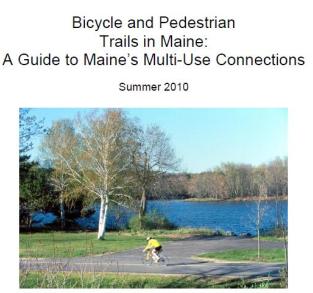 Background: This report provides a listing of Maine Bicycle and Pedestrian Shared Use Trails in Maine, including the Eastern Trail. This report is divided into two sections. The first section lists the bicycle and pedestrian connections that are for nonmotorized uses only. They generally have improved surfaces of either asphalt or stone dust The second section includes Shared Use Paths which also allow ATV’s. All of these trails have been built with partnerships at the local, state, and federal level. They are all open to the public and are built to connect neighborhoods, villages, business areas and towns. This report is meant to be a general outline of bicycle and pedestrian offroad opportunities in Maine.
Walking and Bicycling Trails:
Shared Use Paths: Motorized and NonMotorized Use:
At a meeting with a group of equestrians on January 11, 2012, the Eastern Trail Municipal District lifted the moratorium on horseback riding on the Kennebunk-Arundel-Biddeford section of the Eastern Trial until March 1, 2012, with the understanding that members of the local equestrian community will work with the ETMD to define, by that date, a set of rules and responsibilities to govern their use of the trail, and which they would publicize and support to ensure that the trail can be maintained for all users.
The equestrian community plans on developing rules for equestrians use of the trail to present at the next ETMD meeting on February 8th. FMI, contact the ETA by email or by phone at 207-284-9260.



 Facebook
 Instagram
 YouTube
 X/Twitter