Author: Larry Glantz

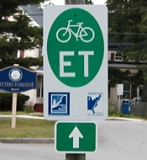
Image of sign on a bike path
Archived News

Be Cool, It’s a Bike Path

Multi-use paths are being added to cities across the country at an exciting rate and more people are using them. That’s a great thing. But crowding can lead to conflict. To stay safe, and make the experience more enjoyable for everyone, here are a few guidelines for blisfully sharing bike paths with fellow cyclists, joggers, dog walkers, and everyone else.

1. Get out of time-trial mode, duh. It’s fun to go fast, but a bike path isn’t the place to seek a KOM. Yes, you can crank things up a bit if you have clear sight lines and few other users but, as a general rule, keep it under control.

2.  Ride right, pass left. Act like a car in these situations. Right for travel, left for passing. And, of course, obey all traffic signals.


3. Slow down—and be prepared to stop—when there are others around. People are unpredictable. Kids and pets especially, but the truth is, anyone can be so involved in a conversation or wrapped up in their own thoughts that they’ll make a bad choice even if they hear you coming. Slow to a walking pace and keep your hands on your brakes.

4. Make some noise well before passing. A bell is more charming(and less startling) than an “on your left!” but either is preferable to a stealth pass. Make noise—be sure you’re heard—well before you reach the person you’re passing.

5. Look around (and signal!) before passing or stopping. Just because you’re doing it right doesn’t mean everyone else is. Before you swing left to pass or hit the brakes to stop, throw out a hand signal, and take a look behind you for oncoming traffic.

6. Don’t stand in the path. Sometimes it’s nice to stop and look around and take a drink. Pull off the path when you do so, otherwise you’ll block the way for everyone else. 

7. Be nice. It’s the most important thing. You’re representing cyclists as a group. Don’t be a stone-faced automaton hell-bent on maintaining your 19.5 mph pace. Treat people the way you want to be treated. Be friendly. Wave. Say hello. It will make all of our time on these super paths a little more fun.

Read the entire article on-line here.

Archived News

Audio tours provide historic view of tri-city area

By LIZ GOTTHELF, Staff WriterA new local initiative, Treetops & Rooftops GIS, is bringing on demand tours of local points of interest.

Treetops & Rooftops, an initiative of Saco Bay Center for Civic Engagement and created by volunteers, has developed a pilot program with three audio tours – historical tours of Pepperell Park in Saco and The Pier in Old Orchard Beach and an audio drama that takes place at a segment of the Eastern Trail in Biddeford behind Southern Maine Health Care.

The tours can be found by going to the Saco Bay Center for Civic Engagement website, www.sacobaycenter.org. Project leader Melissa Field secured the use of a mapping system developed for the Eastern Trail to allow smartphone users to access the audio tours.

“You can take the tour anytime,” said Fields.

Local historian Catherine Glynn worked with students from Katy Nicketakis’ French class at Thornton Academy to develop and narrate the Pepperell Park tour, which includes history of the park and a poem written in 1900 by William Grant Brooks.

The tour was translated by Thornton Academy French students as a class project, and narrated in French by two student volunteers.

Thornton Academy senior Taylor Lamarre said she volunteered last school year to dictate part of the recording because she wants to become more fluent in French.

Lamarre said the project was a lot of fun to work on and she learned a lot about Saco.

“It sounds really, really good: Better than I expected,” she said. “I think it’s really cool that a lot of people are going to be hearing this.”

Read the entire article online here

Archived News

New Eastern Trail spur nears completion in OOB

By LIZ GOTTHELF, Staff Writer
OLD ORCHARD BEACH — A nearly completed new spur trail leads pedestrians and bicyclists from the Eastern Trail to Veterans Memorial Park downtown.

The Eastern Trail, when fully completed, will provide 65 miles of pedestrian and bicycle trails from Kittery to South Portland along the former Eastern Railroad Corridor.

The Eastern Trail was conceived in the 1990s as a “linear park” providing 12 southern Maine communities with a route for bicyclists and pedestrians without motorized traffic, according to a press release from the Eastern Trail Alliance.

“But it was also seen as a potential transportation ‘spine,’ a scenic pathway giving access to each community’s particular offerings and attractions,” Eastern Trail Alliance officials said in the press release. “While other towns have ventured modestly into that promise, Old Orchard Beach is the first to embark on such an ambitious project, aiming both to entice ET users to ‘come on down’ to its central downtown area, and to encourage Old Orchard Beach citizens to get out onto the Eastern Trail.”

The spur trail runs about 2 3/4 miles from the Eastern Trail at Pondview Road to Veterans Memorial Park, providing Eastern Trail users easier and safer access to the downtown, according to a press release from the Conservation Commission. The trail, which is being completed entirely by town resources, runs off road and alongside the road, said Conservation Commission Chairman John Bird in a phone interview.

Last weekend, Conservation Commission members posted trail maps, user information and historical accounts at three newly installed kiosks along the spur trail, according to the press release from the Conservation Commission.

At the end of Pond View Road, the town’s Public Works Department installed a new culvert, 50 feet of trail and a pad for the kiosk, according to the commission’s statement. The Public Works Department has also installed recycled asphalt and gravel mix on 3,500 feet of trail from School Street Extension to Dirigo Road Extension, providing a more firm surface for easier trail use, according to the commission’s statement.

Read the entire article online here

Archived News

The Best Bike Paths on the East Coast Greenway

By Marc Chalufour
AMC Outdoors, September/October 2015

The ambitious effort to create the East Coast Greenway (ECG)—an uninterrupted network of bike paths, some preexisting and some newly constructed, from Calais, Maine, to Key West, Fla.—began in 1991. Today, the off-road portion is nearly one-third complete, with designated roads connecting the dots. These eight segments highlight the best of the ECG in AMC’s region, from urban bike paths to rural rail-trails.

1. EASTERN TRAIL
South Portland, Maine
The Eastern Trail will eventually connect South Portland with Portsmouth, N.H., via 65 miles of bike path. About a third of the project is now complete, including a dedicated bridge in Biddeford that crosses over the Maine Turnpike and the Eastern Trail’s northernmost section, in South Portland. To ride the latter stretch, begin at Bug Light, which overlooks Portland Harbor at the mouth of the Fore River, and pedal west. The trail skirts the river and, after a brief on-road connection, continues on to the Wainwright Athletic Complex.
DISTANCE: 10.8 miles round trip
INFO: AMC’s Best Day Hikes Along the Maine Coast (AMC Books); easterntrail.org

Read the entire article online here

Archived News

In From the Outdoors: Q&A with Paul Schumacher and Lee Burnett, trail advocates

SPRINGVALE — A year ago Paul Schumacher and Lee Burnett began brainstorming over a question local business owners repeatedly asked: Could York County have more connecting trails?

Schumacher, the director of the Southern Maine Planning and Economic Development Commission, said the requests made sense: Trails help tourism, improve quality of life and increase the value of real estate.

So he got together with Burnett, project director at Forest Works!, which conserves forestland in York County, and began to examine the possibility of a large, interconnecting trail network.

What has resulted is a plan to connect the county’s trails using the Eastern Trail as the backbone. The ET runs through South Portland, Scarborough, Old Orchard Beach, Saco, Arundel and Kennebunk, but the goal is to connect it through Wells, South Berwick, North Berwick and Eliot.

How did this project start?

PS: At a meeting two years ago, local businesses kept asking about trails. It’s a quality-of life-issue, a quality-of-place issue. And York County does have a lot of trails on land owned by state agencies, nonprofits, land trusts, municipalities, and land trusts and water districts. What we realized was the (proposed) Eastern Trail here runs right through the center of the region. It could be the backbone of a larger trail network. So we applied for a grant with the Maine Outdoor Heritage Fund and received $12,500. We were able to use it to get a matching grant for $22,000. We’ve spent that data-gathering, mapping, gathering all the trails, using GPS to locate some of the trails.

In a way this was more than we were prepared for. We proposed a trail from the coast to Parsonsfield, near the New Hampshire border, creating an integrated trail system. That was the dream. Now we’ll need money to build the trail network.

LB: It’s challenging because there are a lot of property owners in southern Maine. And a lot of property owners don’t mind people on their land but they don’t want to open it up to the public and have people from Massachusetts littering on their land, or worse. It’s a lot more suburban here.

Read the whole article online here

Archived News

“Adding Trails to Rails Saves Lives” – a 2008 ETA Study

Can Trails Make Rails Safer?
Annually 500 trespassers are killed in rail corridors.
With 142,000 miles of freight corridor, that s an annual fatality rate of One fatality for every 300 miles of rail corridor.
Not even one fatality has been recorded during the 40-year history of rails-with-trails for a pessimistically estimated annual fatality rate of One fatality for every 8000 miles.
Can we explain this 26-to-1 difference in fatality rates?
Americans, rightly or wrongly, consider rail corridors to be trails. If Rails are trails, they are terribly dangerous ones. They are also poor trails, awkward to walk.
Simply by providing a better, nearby trail, people apparently walk on the real trails thus reducing rail trespass fatality rates.

Latest News

MLR Bike Jerseys Can be Ordered Online for Home Delivery

We are excited to again offer a Maine Lighthouse Bike Jersey for 2016 – you can see the new jersey design to the left. You can order one or more jerseys and they will be shipped to you – these make great gifts as well.

Jerseys can be ordered online now – directly from Atayne, which “makes performance outdoor clothing and sports apparel that is safe for people and the planet.”

You can also still order the great jersey designs from our 2015, 2014 and 2013 rides.

More info on the jerseys and pictures here

Latest News

The Governor signed a bill to protect walkers, bicyclists and other vulnerable users!

From our wonderful colleagues at the Bicycle Coalition of Maine:

We are incredibly excited to announce a big victory at the State House for all bicyclists and pedestrians in Maine.

For the past six months we’ve been working hard in support of The Bicycle / Pedestrian Safety and Responsibility Act (LD 1301). On Friday, June 12, Governor LePage signed this important bill into law.

As a result of our hard work, and with the help of thousands of members, supporters, and local, state, and national partners, important improvements that will better protect all users of our roads have now been added to Maine law. This legislation accomplishes three main goals:

1. Maine law now defines a “Vulnerable User” as a person on the public way who is more vulnerable to injury than a person in a motor vehicle. This definition includes pedestrians, bicyclists, wheelchair users, those driving tractors, and others. The new law also strengthens Drivers Education programs by requiring courses to include increased instruction on protecting the rights and safety of vulnerable users.

2. The law also increases protections for walkers, runners, and wheelchair crossing the street by requiring drivers yield to pedestrians who are attempting to cross the street at a marked crosswalk. Before this change, drivers only had to yield when pedestrians at a marked crosswalk stepped out into the road.

3. In addition to the added protections for pedestrians and all vulnerable users, the law also provides needed clarification regarding the responsibilities of bicyclists; namely their duty to obey yield signs, stop signs, one-way streets, and traffic lights.

Please click here for more information, to read the full text of the new law and to view our press release.

We could not have won this campaign without the help of so many members, supporters and partners. Thank you for being a part of this important effort!

https://www.easterntrail.org/